

You’ve decided to ditch disposables. Smart move. But now you’re staring at two very different reusable options: menstrual cups and menstrual discs. They both collect blood, they both last for years, and they both require getting comfortable with your anatomy.
So which one’s right for you?
Let’s cut through the noise and get practical. This is the no-BS comparison that actually tells you what you need to know.
The Showdown: Key Differences at a Glance
| Feature | Menstrual Cup | Menstrual Disc |
| Position | Sits in vaginal canal, below cervix (like a tampon) | Sits in vaginal fornix, behind and below cervix |
| Stays in place by | Light suction seal against vaginal walls | Tucking behind pubic bone (no suction) |
| Capacity | 20-50ml (2-4 tampons’ worth) | 30-80ml (3-6 tampons’ worth) |
| Can you have period sex? | No – must be removed | Yes – mess-free period sex possible |
| IUD-friendly | Use with caution (suction may dislodge IUD) | Generally safer (no suction) |
| Removal messiness | Less messy – cup holds fluid | Can be messier – requires technique |
| Learning curve | Moderate – folding and seal | Moderate to steep – reach and tuck |
| Auto-dumping | Not possible | Possible (disc partially empties on toilet) |
| Sizes available | Many sizes, shapes, and firmnesses | Usually one or two sizes |
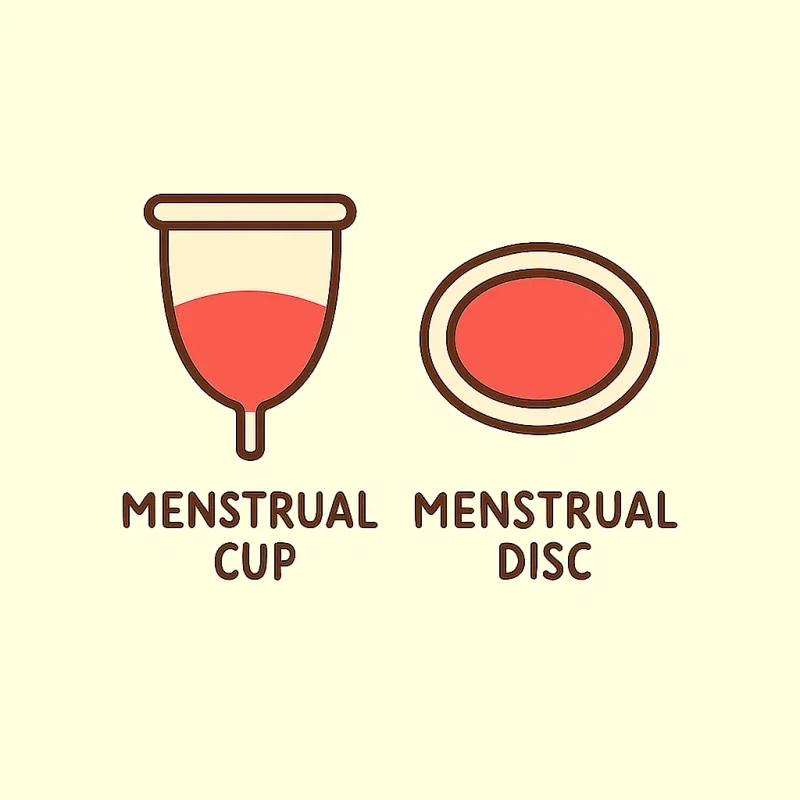
The Menstrual Cup: The Reliable Veteran
Menstrual cups have been around longer, so there’s more variety, more information, and more people who’ve used them successfully.
How It Works
A menstrual cup is exactly what it sounds like: a flexible, bell-shaped cup made from medical-grade silicone or TPE (thermoplastic elastomer). You fold it, insert it into your vaginal canal, and let it pop open. The rim creates a light seal against your vaginal walls, holding it securely in place.
Think of it like sitting in roughly the same spot as a tampon would, but instead of absorbing blood, it collects it. Most cups hold 20-50ml of fluid, which is about 2-4 tampons’ worth. You can wear it for up to 12 hours, then remove it, empty it, rinse it, and pop it back in.
Best For
- Beginners to reusables: Cups are easier for many people to insert correctly on the first try
- People who want variety: Heaps of brands, sizes, firmnesses, and stem options available
- Those with moderate to light flow: Standard capacity works for most people
- Anyone who doesn’t want to reach as far: Cups sit lower than discs
Pros
✅ Easier to remove without mess (cup holds blood as you pull it out)
✅ Huge variety of sizes and shapes to fit your anatomy
✅ More familiar concept for most people
✅ Established brands with years of user feedback
✅ Can often feel when it’s in wrong position
Cons
❌ Creates suction, which may not suit everyone (bladder sensitivity, weak pelvic floor)
❌ Requires breaking seal before removal (extra step)
❌ Can’t be worn during penetrative sex
❌ Higher risk of IUD dislodgement if seal isn’t broken properly
❌ May leak if not positioned correctly under cervix
The Menstrual Disc: The Game Changer
Discs are newer to mainstream awareness, though they’ve been around in disposable form for years. Reusable discs are rapidly gaining fans.
How It Works
A menstrual disc looks like a shallow, flexible bowl with a wide rim. You squeeze it in half lengthwise, insert it horizontally toward your tailbone, then tuck the front rim up behind your pubic bone. It sits in your vaginal fornix – the wider space at the very back of your vaginal canal, just below your cervix.
There’s no suction. It stays in place because the rim is wedged between your pubic bone and the back of your cervix. The disc conforms to this space, which is why many brands offer just one or two sizes.
Best For
- Heavy flow days: High capacity (30-80ml) means longer wear time
- IUD users: No suction means safer for your IUD
- People who want period sex: Only internal product that allows it
- Those with weak pelvic floor or bladder sensitivity: No suction pressure
- Anyone who experiences cup-related discomfort: Different positioning can make all the difference
Pros
✅ Higher capacity than most cups
✅ No suction (safer for IUDs, better for some pelvic floor issues)
✅ Can be worn during penetrative sex
✅ May auto-dump on toilet (partial emptying without removal)
✅ Sits in an area with fewer nerve endings (many find it more comfortable)
✅ One or two sizes fit most people (less guesswork)
Cons
❌ Messier to remove – blood can spill more easily
❌ Requires reaching further into vagina
❌ Steeper learning curve for some
❌ Fewer size and brand options than cups
❌ May untuck during bowel movements if you bear down hard
Period Sex: The Disc Advantage
Let’s address the elephant in the room. Yes, you can have penetrative sex while wearing a menstrual disc. No, you cannot with a cup.
How it works: The disc sits high up in your vaginal fornix, tucked behind your pubic bone. This leaves the vaginal canal clear for penetration. Most people and their partners report not feeling the disc during sex.
Important notes:
- Empty your disc beforehand to minimise any potential mess
- A disc is not contraception – you can still get pregnant
- Friction between a disc and condom may create micro-tears, so consider additional protection
- Some partners may feel the removal tab if your disc has one
The “mess-free” claim is accurate for most people, though there may occasionally be light spotting afterward. If your partner reports feeling the disc uncomfortably, repositioning may help.
Auto-Dumping: Disc’s Secret Weapon
One of the most praised features of discs is auto-dumping (also called self-emptying). Here’s what actually happens:
When you sit on the toilet and relax your pelvic floor muscles to urinate or have a bowel movement, the disc may temporarily untuck from behind your pubic bone. This allows some of the collected blood to pour into the toilet. When you’re done, the disc typically returns to position on its own (or with a gentle nudge).
Why people love it: For heavy flow days, auto-dumping can extend wear time without having to fully remove and reinsert your disc. Instead of changing every 4-6 hours, you might get a full 12 hours.
Reality check: Not everyone experiences auto-dumping. It depends on:
- Your pelvic floor muscle strength
- The disc size and fit
- Your anatomy
- How you position yourself on the toilet
Some people can intentionally trigger it by bearing down gently while on the toilet. Others never experience it at all. Both are normal.
Is it safe? Yes. Auto-dumping only happens when you’re already on the toilet, not randomly throughout the day. If you’re experiencing “dumping” while going about normal activities, that’s actually leaking, which means the disc isn’t positioned correctly or you need a different size.
How to Insert & Remove (Without Panic)
The first few times using any internal reusable product can feel awkward. That’s completely normal. Most people need 1-3 cycles to feel confident.
Menstrual Cup: Step-by-Step
Before you start:
- Wash your hands thoroughly
- Find a comfortable position: sitting on toilet, squatting, or standing with one leg up
- Relax your pelvic floor muscles (tensing makes insertion harder)
- Optional: use water-based lubricant on the rim
Insertion:
- Fold your cup. The most beginner-friendly fold is the “punch-down” or “C-fold.” Push one side of the rim down into the cup, creating a narrow point for insertion.
- Insert horizontally. Aim toward your tailbone, not straight up. The cup should travel back at an angle, not upward.
- Let it open. Once the cup is inserted, release your fold. You should feel or hear it pop open. Run your finger around the rim to ensure it’s fully open and there are no dents.
- Check the cervix. Use your finger to feel around the rim. Your cervix should be inside the cup, not sitting next to it. If your cervix is outside the rim, the cup will leak. Lower the cup slightly so it opens below your cervix.
- Do the seal test. Gently tug on the stem. You should feel slight resistance – that’s the seal working.
Removal:
- Wash your hands.
- Get into position. Same positions as insertion work well.
- Relax your pelvic floor. Tensing makes removal much harder.
- Break the seal. This is critical. Pinch the base of the cup (not just the stem) to release the suction. Some people insert a finger alongside the cup to let air in. Never yank on the stem without breaking the seal first.
- Remove slowly. Keep the cup upright as you pull it out to minimise spills. Empty into toilet.
- Rinse and reinsert. Cold water first (prevents staining), then wash with mild soap or menstrual cup wash.
Menstrual Disc: Step-by-Step
Before you start:
- Same hygiene and positioning advice as cups
- You’ll need to reach further, so be prepared for that
- Water-based lubricant can help during learning curve
Insertion:
- Squeeze the disc. Pinch the disc in the middle so it forms a figure-8 or narrow oval shape.
- Insert horizontally. Aim toward your tailbone. Push the disc back as far as it will comfortably go.
- Angle downward mid-insertion. When the disc is about halfway in, tilt the part that’s already inside so it points down toward the floor. This helps the disc slide under your cervix.
- Tuck it up. Once fully inserted, use your finger to push the front rim up and behind your pubic bone. You should feel it “click” into place. The disc should now be horizontal, sitting in the fornix space.
- Check cervix coverage. Use your finger to feel through the base of the disc. You should be able to feel your cervix (it feels like the tip of your nose) through the material, confirming it’s covered.
Removal:
- Wash your hands.
- Relax. This is the most important step. Tense pelvic floor muscles make everything harder.
- Bear down gently. Like you’re trying to poop. This brings the disc lower.
- Hook your finger. Reach in and hook your index finger under the front rim of the disc (or grab the removal tab/notch if your disc has one).
- Pull down and out. As the disc comes out, tilt it slightly to keep blood from spilling. Some spillage is normal, especially while you’re learning. This is why the shower is your friend for first-time removals.
- Empty, rinse, reinsert. Same process as cups.
Pro tip: If you can’t reach your disc, wait 30 minutes and try again. Walking around helps gravity bring it lower. If you’ve had sex with the disc in, wait even longer – arousal makes the vaginal canal longer.
IUD Safety: What You Need to Know
This is a big concern for many people, and understandably so. Here’s what the research actually shows.
Menstrual Cups and IUDs
A 2020 study found higher IUD expulsion rates in menstrual cup users compared to non-users: 14.3% of cup users expelled their IUD within the first year, versus 4.7% of non-users. By year two, those rates increased to 23.2% and 6.5%, respectively.
However, an earlier 2012 study found no increased risk. The research is limited and doesn’t account for factors like cup type, IUD string length, or whether users properly broke the seal before removal.
If you use a cup with an IUD:
- Wait at least 6 weeks after IUD insertion before using a cup
- Always break the seal before removal – never pull on a suctioned cup
- Consider asking your doctor to trim IUD strings flush with cervix
- Check your IUD strings regularly
- If you notice strings feeling different or can feel the actual IUD, see your doctor immediately
Menstrual Discs and IUDs
Discs are generally considered safer for IUD users because they don’t use suction. There’s no large-scale research on disc-specific IUD expulsion rates, but the mechanism makes sense: no suction means no pulling force.
If you use a disc with an IUD:
- Still wait 6 weeks after insertion
- Be gentle during insertion and removal
- Check strings regularly
- Some doctors still recommend trimmed strings for extra safety
Bottom line: Both can be used with IUDs, but discs have a theoretical safety advantage. Talk to your healthcare provider about your specific situation.
Top Australian Picks
Here are trusted brands available in Australia:
Menstrual Cups
Hello Cup (AU$45-56)
- Made from TPE (good for silicone allergies)
- Comes in sizes for different cervix heights
- Double-rim design helps it pop open
- Available through Period Shop and Menstrual Cups Australia Online
Saalt Cup (AU$45)
- Medical-grade silicone
- Two firmnesses available (regular and soft)
- Multiple sizes
- 90-day satisfaction guarantee
Lunette (AU$49)
- Medical-grade silicone
- Popular beginner cup
- Wide colour range
- FDA approved
Menstrual Discs
Hey Zomi Disc (AU$55)
- Australian-made
- Soft, flexible silicone
- Single loop handle for removal
- One size fits most
- Available in black or nude
Saalt Disc (AU$66)
- Two sizes available (small and regular)
- Custom finger notch for removal
- Medical-grade silicone
- Made in USA, widely available in Australia
Hello Disc (AU$57)
- Patented double-looped tab design
- One size
- Easy removal claimed as key feature
- TPE option available
Ovolo Disc (AU$28)
- Budget-friendly option
- Medical-grade silicone
- Removal tab
- Good starter disc
Where to buy: Period Shop, Menstrual Cups Australia Online, and directly from brands like Hey Zomi.
The Learning Curve: What to Actually Expect
Let’s be honest: your first insertion probably won’t be perfect. That’s normal.
Typical timeline:
- First try: Might take 10-15 minutes. May not position correctly. Possible leaking.
- First cycle: Figuring out your rhythm. Some successes, some frustrations.
- 2-3 cycles: Confidence building. Less thinking required.
- After that: Second nature.
Tips for success:
- Use backup. Pair with period underwear or a pad while learning.
- Try in the shower. Less stress about mess.
- Dry runs help. Practice insertion when you’re not on your period (after sanitising your product).
- Track what works. Note which fold, position, or technique works best for you.
- Don’t compare yourself to TikTok. Those “first time, perfect!” videos aren’t representative.
- Blood on your hands is normal. This is body literacy, not gross. Wash and carry on.
- Give it time. Three cycles is the minimum before deciding something doesn’t work.
Who Should Skip These?
Reusables aren’t for everyone, and that’s fine.
Consider other options if:
- You have vaginismus or severe pelvic pain
- Your healthcare provider has advised against internal products
- You’re not comfortable inserting fingers into your vagina
- You have an active vaginal infection (wait until treated)
- You’re in early postpartum recovery (wait at least 6 weeks)
Period underwear, reusable pads, and organic disposables are all valid choices.
The Bottom Line
Choose a cup if you want:
- Less messy removal
- More size and firmness options
- Lower insertion (don’t want to reach as far)
- Established product with lots of resources
Choose a disc if you want:
- Higher capacity for heavy flow
- Period sex capability
- IUD-safer option
- Auto-dumping possibility
- Suction-free experience
Or try both. Many people use cups on lighter days and discs on heavy days. There’s no rule saying you must commit to one.
The best reusable period product is the one you’ll actually use. Start with whichever appeals to you, give it an honest 2-3 cycle trial, and adjust from there.
Your period doesn’t have to involve mountains of waste. Whether you choose a cup, a disc, or something else entirely, making the switch to reusables is a win – for your body, your wallet, and the planet.
Now go forth and get acquainted with your anatomy. You’ve got this.